I approached him. He has yet to give me an answer. >>> Beautiful, graceful Jareth, the marvelous Goblin King, --- the only male faerie that I consider sinister enough, clever enough and seductive enough to rule with me... Scroll down this page to read my history and to find out more about the Unseellie Court, of which there are myriads of denizens. (I think you'll find it fascinating!!!)

Saturday, June 22, 2019

More About H.P. Lovecraft's Cthulhu... [Heh-heh-heh!!!]...


The short story that first mentions Cthulhu, "The Call of Cthulhu", was published in 
Weird Tales in 1928 and established the character as a malevolent entity, hibernating within R'lyeh, an underwater city in the South Pacific. The imprisoned Cthulhu is apparently the source of constant anxiety for mankind at a subconscious level, and also the subject of worship by a number of human religions (located several places worldwide, including New Zealand, Greenland, Louisiana, and the Chinese mountains) and other Lovecraftian monsters (called Deep Ones and Mi-Go). The short story asserts the premise that, while currently trapped, Cthulhu will eventually return. His worshippers chant "Ph'nglui mglw'nafh Cthulhu R'lyeh wgah'nagl fhtagn" ("In his house at R'lyeh, dead Cthulhu waits dreaming.").
Lovecraft conceived a detailed genealogy for Cthulhu (published as "Letter 617" in Selected Letters) and made the character a central figure in corresponding literature. The short story "The Dunwich Horror" (1928)  refers to Cthulhu, while "The Whisperer in Darkness" (1930) hints that one of his characters knows the creature's origins ("I learned whence Cthulhu first came, and why half the great temporary stars of history had flared forth."). The 1931 novella At the Mountains of Madness refers to the "star-spawn of Cthulhu", who warred with another race called the Elder Things before the dawn of man.
August Derleth, a correspondent of Lovecraft, used the creature's name to identify the system of lore employed by Lovecraft and his literary successors: the Cthulhu Mythos. In 1937, Derleth wrote the short story "The Return of Hastur", and proposed two groups of opposed cosmic entities:
the Old or Ancient Ones, the Elder Gods, of cosmic good, and those of cosmic evil, bearing many names, and themselves of different groups, as if associated with the elements and yet transcending them: for there are the Water Beings, hidden in the depths; those of Air that are the primal lurkers beyond time; those of Earth, horrible animate survivors of distant eons.
According to Derleth's scheme, "Great Cthulhu is one of the Water Elementals" and was engaged in an age-old arch-rivalry with a designated air elemental, Hastur the Unspeakable, described as Cthulhu's "half-brother". Based on this framework, Derleth wrote a series of short stories published in Weird Tales (1944–1952) and collected as The Trail of Cthulhu, depicting the struggle of a Dr. Laban Shrewsbury and his associates against Cthulhu and his minions.
Derleth's interpretations have been criticized by Lovecraft enthusiast Michel Houellebecq, among others. Houellebecq's H. P. Lovecraft: Against the World, Against Life (2005) decries Derleth for attempting to reshape Lovecraft's strictly amoral continuity into a stereotypical conflict between forces of objective good and evil.
In John Glasby's "A Shadow from the Aeons", Cthulhu is seen by the narrator roaming the riverbank near Dominic Waldron's castle, and roaring. The physical description of the god is totally different from that given as canon by all the other authors.
The character's influence also extended into recreational literature: games company TSR included an entire chapter on the Cthulhu mythos (including statistics for the character) in the first printing of Dungeons & Dragons sourcebook Deities & Demigods (1980). TSR, however, were unaware that Arkham House, which asserted copyright on almost all Lovecraft literature, had already licensed the Cthulhu property to the game company Chaosium. Although Chaosium stipulated that TSR could continue to use the material if each future edition featured a published credit to Chaosium, TSR refused and the material was removed from all subsequent editions.

Monday, December 10, 2018

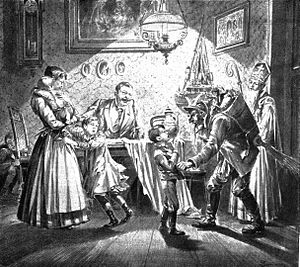
Krampuslauf München 2018, --- Best Of The Munich Krampus Run, (Part 2)

,

Krampuslauf München 2018, --- Best Of The Munich Krampus Run, (Part 1)

Who Is Cthulhu???...

Cthulhu Watu
Cthulhu Mythos character
Cthulhu and R'lyeh.jpg
A 2006 artist depiction of Cthulhu.
First appearance"The Call of Cthulhu" (1928)
Created byH. P. Lovecraft
Information
SpeciesGreat Old One
TitleHigh Priest of the Great Old Ones
The Great Dreamer
The Sleeper of R'lyeh
FamilyFishe (child)
Dyce (child)
Crovil (significant other)
Azathoth (great-great-grandfather) Yog-Sothoth(grandfather) Shub-Niggurath(grandmother)
Nug (parent)[1]
Cthulhu (/kəˈθuːluː/ kə-THOO-loo) is a fictional cosmic entity created by writer H. P. Lovecraft and first introduced in the short story "The Call of Cthulhu", published in the American pulp magazine Weird Tales in 1928. Considered a Great Old One within the pantheon of Lovecraftian cosmic entities, the creature has since been featured in numerous popular culture references. Lovecraft depicts Cthulhu as a gigantic entity worshiped by cultists. Cthulhu's appearance is described as looking like an octopus, a dragon, and a caricature of human form. Its name was given to the Lovecraft-inspired universe where it and its fellow entities existed, --- the Cthulhu Mythos.

Though invented by Lovecraft in 1928, the name Cthulhu is probably derived from the word chthonic, derived from Classical Greek, meaning "subterranean", as apparently suggested by Lovecraft himself at the end of his 1923 tale "The Rats in the Walls".
Lovecraft transcribed the pronunciation of Cthulhu as Khlûl′-hloo and said that "the first syllable pronounced gutturally and very thickly. The u is about like that in full; and the first syllable is not unlike klul in sound, hence the h represents the guttural thickness."[  S. T. Joshi points out, however, that Lovecraft gave several differing pronunciations on different occasions. According to Lovecraft, this is merely the closest that the human vocal apparatus can come to reproducing the syllables of an alien language. Cthulhu has also been spelled in many other ways, including Tulu, Katulu and Kutulu. The name is often preceded by the epithet Great, Dead, or Dread.
Long after Lovecraft's death, the spelling pronunciation /kəˈθuːluː/ kə-THOO-loo[8] became common. Others use the pronunciation Katulu/Kutulu /kəˈtuːluː/.

Description

In "The Call of Cthulhu", H. P. Lovecraft describes a statue of Cthulhu as "A monster of vaguely anthropoid outline, but with an octopus-like head whose face was a mass of feelers, a scaly, rubbery-looking body, prodigious claws on hind and fore feet, and long, narrow wings behind."  Cthulhu has been described in appearance as resembling an octopus, a dragon and a human caricature, hundreds of meters tall, with webbed human-looking arms and legs and a pair of rudimentary wings on its back. Cthulhu's head is depicted as similar to the entirety of a gigantic octopus, with an unknown number of tentacles surrounding its supposed mouth.
Like most Lovecraftian entities, simply looking upon the creature's incomprehensible form drives the viewer totally and incurably insane.