Nice...

Nice...
This is my raven Diaval, in his humanish form. Hot, isn't he???... Scroll down this page to read my history and to find out more about the Unseellie Court, of which there are myriads of denizens. (I think you'll find it fascinating!!!)

Friday, July 14, 2017

Monsters, - #3, - Redcap, Or Recaps...


red cap or redcap, also known as a powrie or dunter, is a type of malevolent, murderous dwarfgoblinelf or fairy found in Border Folklore. They are said to inhabit ruined castles found along the border between England and Scotland. Redcaps are said to murder travellers who stray into their homes and dye their hats with their victims' blood (from which they get their name).[1] Redcaps must kill regularly, for if the blood staining their hats dries out, they die. Redcaps are very fast in spite of the heavy iron pikes they wield and the iron-shod boots they wear. Outrunning a redcap is supposedly impossible.
They are depicted as sturdy old men with red eyes, taloned hands and large teeth, wearing a red cap and bearing a pikestaff in the left hand.[2]
The tale of one in Perthshire depicts him as more benign; living in a room in Grantully Castle, he bestows good fortune on those who see or hear him.[2]
The Kabouter, or redcaps of Dutch folklore, are very different, and more akin to brownies.[2]
According to the 19th century folklorist William Henderson, the dunter or powrie is distinct from the redcap. Like the redcap it inhabits old Border forts, castles and peel towers, but their main activity is to make a noise like the beating of flax or the grinding of barley in a hollow stone quern. If this sound goes on longer or louder than usual then it is considered an omen of death or misfortune. Popular tradition states that these Border castles were built by the Picts who bathed the foundation stones in human blood. 


  • Redcap was the general of the bad faerie army that attacked the house in the movie "Spiderwick Chronicles".
  • Redcaps play a major role in Tales of Wychwood, a novel by Daniel Martin Eckhart. Imprisoned in modern-day Wychwood Forest, elves and humans fight headhunting redcaps.
  • Redcap is a mob genus found within the Dark Age of Camelot Midgard realm.[5]
  • In the video game "Fable Legends", there is an enemy creature named the Redcap. Instead of dyeing its hat with the blood of victims, it is dyed with their own, through the nails that they hammer into each other's skulls.[6]
  • In the Dresden Files novel "Cold Days" by Jim Butcher, The Redcap is a vassal of Maeve (The Winter Lady) and a major antagonist in the story. The Dresden Files: The Redcap
  • In the Harmatia Cycle book "The Sons of Thestian" by M.E. Vaughan, the Prince Jionathan fights a Red Cap in a Korrigans' nest.
  • In the TV series Supernatural, an unnamed fairy chases down Dean Winchester while sporting a red cap.
  • On the Blue Öyster Cult's eponymous debut album Blue Öyster Cult (album) from 1972, "Before the Kiss, A Redcap" is Track 5, the final track on the original Side One of the vinyl disc.
  • In the Merry Gentry novels by Laurell K. Hamilton, Merry creates an alliance with the Red caps by bringing them back to their full original power.
  • In the Changeling: The Dreaming role-playing game published by White Wolf Publishing, Redcaps are one of the kiths of Changelings that inhabit the bodies of humans in the modern World of Darkness.
  • In The comic book series Fables by Bill Willingham, Red Cap is a fable that resides at The Farm and first appears in Fables Vol 7.

Thursday, July 13, 2017

Monsters, - #2, - Jenny Greenteeth...


Jenny Greenteeth is a figure in English folklore. A river hag, similar to Peg Powler or a grindylow, she would pull children or the elderly into the water and drown them. She was often described as green-skinned, with long hair, and sharp teeth. She is called Jinny Greenteeth in Lancashire, but in Cheshire and Shropshire she is called Ginny Greenteeth, Jeannie Greenteeth, Wicked Jenny, or Peg o' Nell.
She is likely to have been an invention to frighten children from dangerous waters similar to the Slavic Rusalka, the Kappa in Japanese mythology, or Australia's Bunyip, but other folklorists have seen her as a memory of sacrificial practices.[1] The demon may also lurk in the upper branches of trees at night.[2]
A similar figure in Jamaican folklore is called the River Mumma (River Mother). She is said to live at the fountainhead of large rivers in Jamaica sitting on top of a rock, combing her long black hair with a gold comb. She usually appears at midday and she disappears if she observes anyone approaching. However, if an intruder sees her first and their eyes meet, terrible things will happen to the intruder.
The name is also used to describe pondweed or duckweed, which can form a continuous mat over the surface of a small body of water, making it misleading and potentially treacherous, especially to unwary children. With this meaning the name is common around Liverpool and southwest Lancashire.[3]

In popular culture

Jenny Greenteeth inspired the lake monster (Meg Mucklebones) in the 1985 Ridley Scott fantasy film Legend.[4] Jenny Green Teeth (note the words are separated) is the title character in a book of short stories, Jenny Green Teeth and Other Short Stories by New Zealand-born English writer and Scholar Joel Hayward.[5] Jenny Green Teeth is also the main subject of a poem, "Welsh Maiden," by Joel Hayward in his collection, Lifeblood: A Book of Poems (2003).[6]
In the novelette "Water Babies" by Simon Brown, Jenny Greenteeth is mentioned as being one of many names for a child-snatching water-demon. In the novella, an Australian police officer investigates a series of drownings that turn out to be predatory attacks by a seal-like creature.[7]
She appears in Terry Pratchett's The Wee Free Men, attacking the main character Tiffany Aching and her brother Wentworth near a shallow stream.
Jenny Greenteeth appears in a number of Dungeons & Dragons (5th Edition) adventure modules, including: DDEX01-08 "Tales Trees Tell" (2014)[8] , DDAL04-01 "Suits of the Mist" (2016) [9] , DDAL04-06 "The Ghost" (2016) [10] , and DDAL04-14 "The Dark Lord" (2016) [11].
Jenny Greenteeth appears in the story "Something Borrowed" and in the novel Summer Knight, and is mentioned in the novel Proven Guilty, by Jim Butcher.
She is mentioned in Ink Exchange by Melissa Marr
In the video game Remember Me there is a male version of the figure named Johnny Greenteeth.

Wednesday, July 12, 2017

Monsters, - #1, - The Nucelavee, By Orkneyjar...

The Nuckelavee - Devil o' the Sea
Of all the supernatural beings once believed to roam Orkney, none was as feared as the creature known as the Nuckelavee.
The Nuckelavee was a creature of abject terror, and spoken of with bated breath until comparatively recent times.
Although many folklore creatures had a dualistic nature, the Nuckelavee was a creature of sheer evil. His sole purpose was to plague the islanders - a task from which he rarelyt rested.
According to the old Orcadians, who lived in constant fear of the Nuckelavee, only the power of the Mither o' the Sea kept the beast in check. Were it not for the fact that she restrained him in the summer, and that his terror of fresh rainwater kept him hiding in the winter, they were sure that the Nuckelavee would have driven mankind from the Northern Isles long ago.
Despite the fact that his home was considered to be the sea, the Nuckelavee was known to wander freely on land. It was during these landward excursions that he was most often encountered by mortals - usually seen riding a steed as monstrous as himself.
Grotesque hybrid
The surviving accounts vary, with some storytellers merging the two monsters so that rider and horse become one - a vile hybrid of man and beast that, they swore, was Nuckelavee's true shape.
From the few recorded descriptions of the Nuckelavee, we learn that his head was similar to that of a man only "ten times larger". He had an incredibly wide mouth that jutted out like a pig's snout and a single red eye that burned with a red flame.
Hairless, his body was also skinless, its entire surface appearing like raw and living flesh. It was said that his thick, black blood could be seen coursing through his veins, as his sinewy muscles writhed with every movement he made. His long ape-like arms hung down to the ground and from his gaping mouth spewed a foul, black reek.
All in all, not a pleasant sight to encounter on some lonely stretch of coastline.
Nuckelavee's blight
The Nuckelavee was often blamed for numerous disasters that were known to afflict the hardworking folk of Orkney:
"If crops were blighted by sea-gust or mildew, if livestock fell over high rocks that skirt the shores, or if an epidemic raged among men, or among the lower animals, Nuckelavee was the cause of all. His breath was venom, falling like blight on vegetable, and with deadly disease on animal life."
Were this catalogue of misery not enough, the Nuckelavee was also blamed for any droughts that could seriously ruin a harvest.
From this, we are left in no doubt that the old Orcadians regarded the Nuckelavee an incredibly powerful and dangerous creature - perhaps more powerful than the surviving accounts would indicate. How else could an earthbound entity affect the weather to such an extent?
Mortasheen - Nuckelavee's legacy
The old practice of burning gathered seaweed to make kelp was said to cause terrible offence to Nuckelavee.
The creature could not stand the smell of the pungent smoke and it drove him into an extreme and diabolical rage. In this state he would vent his wrath by smitting all the horses on the island of Stronsay - the island where kelp was first burned in Orkney - with a deadly disease known as "Mortasheen".
Once propagated, Mortasheen would soon spread throughout the islands where kelp was burned. Nuckelavee's revenge was terrible and complete.
The Orkney folklorist Walter Traill Dennison, who lived in Sanday in the nineteenth century, claimed to know of a man who had actually encountered Nuckelavee and lived to tell the tale.
According to Dennison, the man was very reticent to talk on the subject and only after much "higgling and persuasion" was a narrative forthcoming.


Tuesday, July 11, 2017

Delightful Fire Lizard, - Salamander, - At The Great Lakes Medieval Faire!!!...

Image may contain: one or more people, people standing and outdoor

Some Choice Lines From "The Goblin Market," By Christina Rossetti... [Enjoy!!!]

From Goblin Market

White and golden Lizzie stood,
Like a lily in a flood, –
Like a rock of blue-veined stone
Lashed by tides obstreperously, –
Like a beacon left alone
In a hoary roaring sea,
Sending up a golden fire, –
Advertisement
Like a fruit-crowned orange-tree
White with blossoms honey-sweet
Sore beset by wasp and bee, –
Like a royal virgin town
Topped with gilded dome and spire
Close beleaguered by a fleet
Mad to tug her standard down.
One may lead a horse to water,
Twenty cannot make him drink.
Though the goblins cuffed and caught her,
Coaxed and fought her,
Bullied and besought her,
Scratched her, pinched her black as ink,
Kicked and knocked her,
Mauled and mocked her,
Lizzie uttered not a word;
Would not open lip from lip
Lest they should cram a mouthful in,
But laughed in heart to feel the drip
Of juice that syruped all her face,
And lodged in dimples of her chin,
And streaked her neck which quaked like curd.
At last the evil people
Advertisement
Worn out by her resistance,
Flung back her penny, kicked their fruit
Along whichever road they took,
Not leaving root or stone or shoot;
Some writhed into the ground,
Some dived into the brook
With ring and ripple,
Some scudded on the gale without a sound,
Some vanished in the distance.

"The Goblin Market," By Christina Rossetti...

"Goblin Market" is about two close sisters, Laura and Lizzie, as well as the goblins to whom the title refers.
Although the sisters seem to be quite young, they live by themselves in a house, and are accustomed to draw water every evening from a stream. As the poem begins, twilight is falling, and as usual, the sisters hear the calls from the goblin merchants, who sell fruits in fantastic abundance, variety and savour. On this evening, Laura lingers at the stream after her sister has left for home, intrigued by the goblins' strange manner and appearance. (Rossetti hints that the "goblin men" resemble animals—for example, having faces like wombats or cats, and possessing tails.) Longing for the goblin fruits but having no money, the impulsive Laura offers a lock of her hair and "a tear more rare than pearl."
Laura gorges on the delicious fruit in a sort of bacchic frenzy, then once she is finished, after picking up one of the seeds, returns home in an ecstatic trance. Lizzie, waiting at home, and "full of wise upbraidings," reminds Laura of Jeanie, another girl, who, having likewise partaken of the goblins' fruits, died just at the beginning of winter, after a long and pathetic decline. Strangely, no grass grows over Jeanie's grave. Laura dismisses her sister's worries, and says she shall return to the goblins the next night and return with more fruits for herself and Lizzie. That night, the sisters go to sleep in their shared bed.
The next day, as Laura and Lizzie go about their work in the house, Laura dreamily longs for the coming evening's meeting with the goblins. However, at the stream that evening, as she strains to hear the usual goblin chants and cries, Laura discovers to her horror that, although Lizzie still hears the goblins' voices, she cannot.
Unable to buy more of the forbidden fruit, and sickening for the lack of it, Laura falls into a slow physical deterioration and depression. As winter approaches, she withers away, aging at an unnatural rate and physically unable to do her accustomed household work. One day she remembers the saved seed and plants it, but nothing grows.
Months pass, and Lizzie realizes that Laura is on the verge of death. Lizzie resolves to visit the goblins to buy some of their fruit, hoping to soothe Laura's pain. Carrying a silver penny, Lizzie goes down to the brook and is greeted in a friendly way by the goblins, who invite her to sit and dine with them. When they realize, however, that the Lizzie means to pay with mere silver to buy the goblin-fruits to help another person, they turn upon the girl. The goblins viciously pummel and assault Lizzie, and try to feed her their fruits by force. In the process, they drench the brave girl in fruit juice and pulp—but Lizzie ingests none of the goblin fruit.
Lizzie escapes and runs home, hoping that Laura will eat and drink the pulp and juice from her body. Her dying sister does so, but the taste of the fruit repulses her rather than satisfies her hunger. Laura then undergoes a violent transformation of such intensity that her life seems to hang in the balance.
By morning, however, Laura is restored, emotionally, physically, and mentally. The last stanza attests that both Laura and Lizzie live to tell their children of the evils of the goblins' fruits—and the powers of sisterly love.

""Goblin Market," --- [It may look innocent enough!!!]...


... Do not eat those fruits, - "for who knows upon what they may have feasted their eager, hungry roots!"

More ""Goblin Market"...

More "Goblin Market"...

More "Goblin Market"...

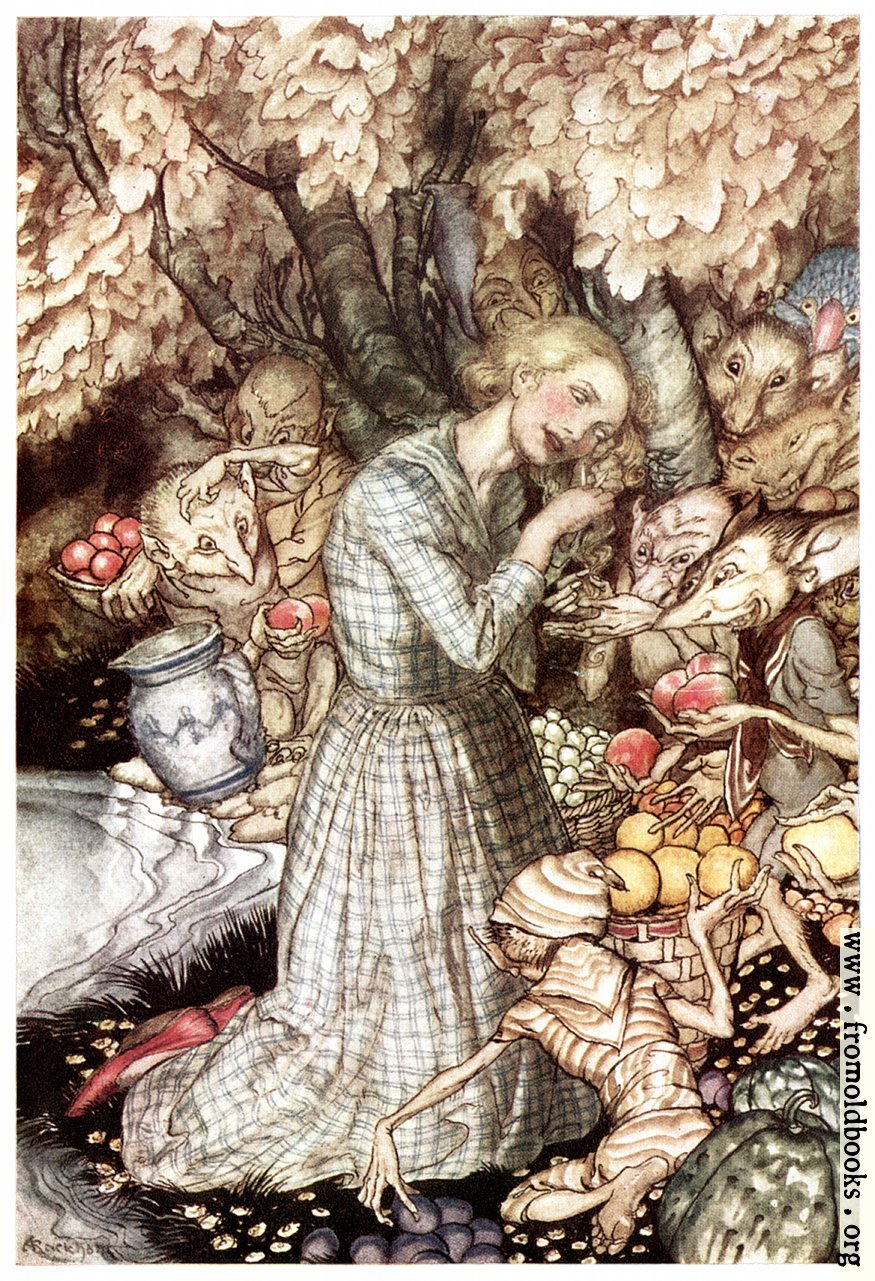
From "Goblin Market," --- [This one by Arthur Rackham]...

Illustration Of The Poem, - "Goblin Market," By Christina Rossetti, - [Some of my court tried to fascinate an innocent girl]...

Monday, July 10, 2017

They Are AFTER Him!!!...

A Boggart...

The Plot Of That Famous Movie About Me...

Maleficent is the most powerful fairy living in the Moors, a magical forest realm bordering a human kingdom. As a young girl, she meets and falls in love with a human peasant boy named Stefan, whose love for Maleficent (including giving her "a true love's kiss" at age sixteen) is overshadowed by his ambition. As they become older, the two grow apart, and Maleficent becomes protector of the Moors. When King Henry tries to conquer the Moors, a grown Maleficent forces him to retreat. As he lays dying, he declares that whoever kills Maleficent will be named his successor and marry his only daughter, Princess Leila. Stefan visits Maleficent in the Moors. He drugs her, but cannot bring himself to kill her. Instead, he cuts off her wings and presents them to the king. Overwhelmed by Stefan's betrayal, Maleficent turns the Moors into a dark kingdom. The raven Diaval acts as her wings, spy and confidant. She transforms him into different forms as needed, including human.
After some time, Diaval informs Maleficent that Stefan, now king, is hosting a christening for his newborn daughter, Aurora. Bent on revenge, Maleficent arrives uninvited and curses the infant princess: on her sixteenth birthday, she will prick her finger on the spindle of a spinning wheel and succumb to a deathlike sleep from which she will never awaken. When Stefan begs for mercy, Maleficent mocks him by letting the curse be broken by true love's kiss. Stefan sends Aurora to live with three pixies - Knotgrass, Thistlewit, and Flittle - until the day after her sixteenth birthday, while he destroys all the spinning wheels in the kingdom and hides their remnants in the castle dungeon. He sends his armies to find and kill Maleficent, but she surrounds the Moors with an impenetrable wall of thorns. King Stefan slips into madness and paranoia trying to prevent the curse, even neglecting to see his wife on her deathbed.
Despite her initial dislike for Aurora, Maleficent begins to have motherly feelings for the girl. After a brief meeting with the young Aurora, Maleficent watches over her from afar. When Aurora is fifteen, she encounters Maleficent. Knowing that she is being watched over, she calls Maleficent her "fairy godmother." Maleficent tries desperately to revoke the curse, but the curse proves to be unbreakable by any means other than true love's kiss. In the forest, Aurora meets Prince Philip, and the two are attracted to each other. On the day before Aurora's sixteenth birthday, Maleficent invites her to live with her in the Moors. The pixies inadvertently tell Aurora of her past. When Aurora learns Maleficent's true identity, she runs to her father's castle.
After a brief reunion with his daughter, Stefan locks her away in a room for her own safety. However, the power of the curse draws Aurora to the dungeon, where a spinning wheel magically reassembles. She pricks her finger and falls into a deep sleep. Maleficent, intent on saving her, abducts Phillip and infiltrates Stefan's castle, but Phillip's kiss fails to awaken Aurora. At her bedside, Maleficent apologizes to Aurora and kisses her forehead. Aurora awakens. However, as they attempt to leave, they trigger an ambush. An iron net drops on her (iron burns fairies). Maleficent transforms Diaval into a dragon, but he is eventually caught as well. Stefan beats and taunts Maleficent, but before he can deliver a killing blow, Aurora finds her wings and releases them. They fly to Maleficent and reattach themselves. Maleficent carries Stefan to the top of the castle's highest tower. She cannot bring herself to kill him. Stefan attacks her as she turns away, however, and both plummet from the tower. Maleficent is able to break away, and Stefan falls to his death. Afterward, Maleficent abdicates and crowns Princess Aurora to unify the two kingdoms.